

January 7, 2026
By James Earl Owens, PhD — Research assistance from members of Truth + Justice 4 Palestine, a grassroots coalition seeking broader racial and ideological diversity in WAMC content and staffing.
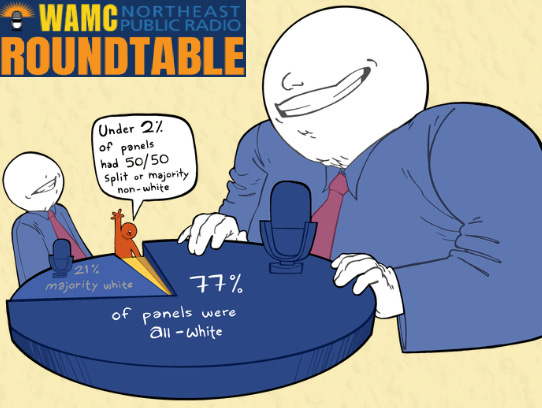
WAMC, the seven-state New England NPR affiliate, makes big promises about their dedication to inclusion and to listening to the needs of audiences. WAMC management reported to the federal government (Guidestar, 2025), that listening to audiences helps “To identify where we are less inclusive or equitable across demographic groups.” I offer this post as an example of listener feedback that explicitly identifies The Roundtable as one place where WAMC is “less inclusive or equitable across demographic groups.” The data presented below covers two full years of Roundtable episodes and documents a clear pattern of white dominance that worsened to extreme levels over the last 12 months. The growing racial imbalance I document spans nearly the entire period of Israel’s war on Gaza and the first year of the Trump regime’s implementation of police power to racially profile and terrorize millions. As such, the data evidences a failure to present the precise kind of “inclusive” and “equitable” news coverage as claimed in WAMC’s branding efforts.
Will station managers fulfill their promises to listen and redress the growing problem of racism on The Roundtable? Without significant listener pressure that seems unlikely. After all, WAMC managers and producers knew about this problem for a long time. Recent campaigns generated almost 1,000 emails to station managers demanding increased Palestinian representation on the show. Audience members called for increased racial diversity at two live Roundtable events (9/19/24,1 7/8/252). Listeners also posted complaints on the station’s social media accounts — only to find that discussion erased. I contacted WAMC multiple times about findings about my prior data on racial exclusions on the program. I also presented my findings to WAMC’s Board of Trustees in June 2025. Despite the fact that station managers and program producers knew there was a racial inclusion problem on The Roundtable, the problem grew more extreme over the past year, as the data released in this post shows.
The choices Roundtable producers make about who to include on the show affects the organization of power. WAMC is an infrastructure of mass communication. Station managers and producers organize power as they racially regulate access to that means of regional communication. As shown by the data, BIPOC panelists receive far less access. That means less power to communicate their rights to existence and autonomy, to point out the political conditions that oppress those rights, and to advance agendas that protect those rights. Finally, the marginalization of BIPOC people on The Roundtable reinforces the racist expectation that news and political discussion should largely be domains for white people.
New Englanders need a radio station to help us defeat the racist authoritarianism emerging around us, and that means addressing racism at WAMC.
(As always, the data referenced in this post is available on GitHub.)
You can help WAMC address their racial exclusion problem and help shift power in New England!
Join the hundreds of people writing letters demanding more diversity and more inclusion of Palestinian and Middle East guests on ‘The Roundtable.’
Call station managers: (518) 465-5233
Call WAMC’s Listener Comment Line: (800) 695-9170
Get involved with Truth + Justice 4 Palestine
Share this post on your social media of choice!
Whites occupy increasingly extreme proportion of Roundtable appearances during second year of Gaza war
White panelists increased their dominance on RT panels to extreme levels during the second year of the Gaza war and did so at the expense of other groups already marginalized. This is according to data spanning 10/9/23 to 10/3/25, a two-year period covering virtually the entire period of Israel’s genocidal3 and ongoing4 war on Gaza. During those two years, The Roundtable aired 451 episodes hosting 1,547 panelist appearances. White panelists increased their proportional presence from 88% of appearances during the first year to 92% during the second year (Figure 1).
Figure 1.
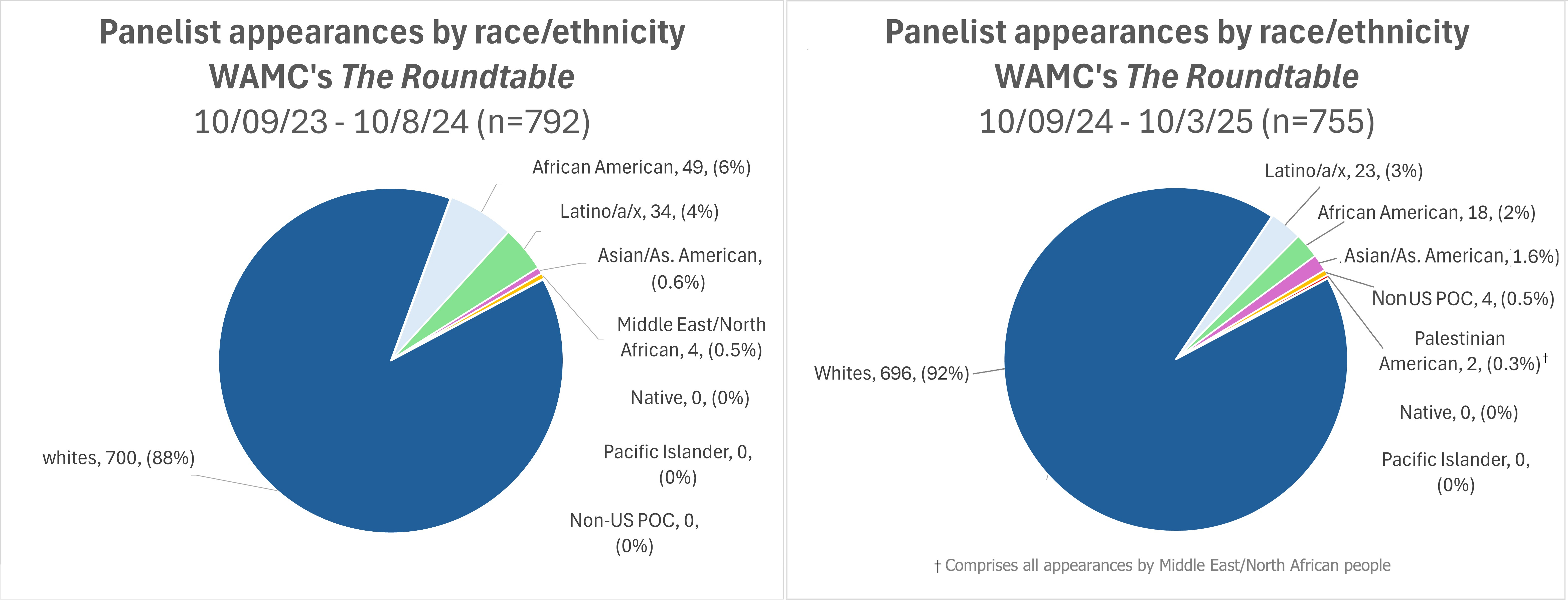
Other racial groups declined in number and proportion of appearances across the two-year period. African Americans made 49 appearances from 2023 to 2024 but only 18 appearances from 2024 to 2025, slipping from 6% to 2% of all appearances. Latino/a/x appearances declined from 34 (4%) to 23 (3%). Asian Americans were the only exception to this pattern, rising from only 3 (.6%) appearances in 2023-24 to 12 (1.6% of all appearances) in 2024-25.
Episodes during the second year of the war did feature Roundtable’s long overdue inclusion of a Palestinian American panelist (Dr. Ahmad Abu-Hakmeh) — after a 19-month campaign overcoming RT producers’ initial refusal to communicate with members of the local Middle East community and pro-Palestine organizations. Unfortunately, Dr. Abu-Hakmeh’s two appearances constituted the only inclusion of Middle East/North African (MENA) people in Roundtable’s coverage of the second year of the Gaza war. This means representation of MENA people actually declined from 4 appearances (.5%) during the first year of the war to only 2 (.3%) in the second year.
Across the two years of episodes, no Native Americans, no Pacific Islanders appeared, and only 4 persons of color from outside the US appeared. Regular inclusion of people from these communities, alongside MENA and Palestinians, could have enabled them to share knowledge and experience of the real-world oppressions of colonization and imperialism — such as longstanding US support for Israeli colonization of Palestine (New York Times, 6/20/1899;5 Khalidy, 2020;6 Al-khersan & Shahshahani, 20257) and US military domination of Latin America (Grandin, 20258) and Africa (US Africa Command, 2008; Gwatiwa & van der Merwe, 20209). Instead of enabling people from these directly affected communities to share their agendas addressing existential problems of war and colonization, Roundtable producers conferred vastly more communicative power to the racial group most over-represented in mainstream media: whites (Scharrar, Ramasubramanian, & Banjo, 202210).
The profound and worsening racial imbalance on The Roundtable is aptly summarized by comparing the ratio of white to BIPOC representation. In the 2023-24 period, whites appeared 7 times more often than all other racial groups combined. In the 2024-25 period whites appeared 12 times more often than all other racial groups combined.
Analysis so far compares patterns of exclusion by looking at the total set of panelist appearances for each year. Yet we actually experience news on a day-to-day basis. Daily repeated patterns model dominant practices as ‘natural’ or ‘to be expected’ (Len-Ríos, 202311). To explore how source selection practices by WAMC producers shape day-to-day discussions of news, policies, and rights, the next section analyzes racial diversity on daily Roundtable panels.
White domination of daily Roundtable panels increased to new extreme levels during 2024-25
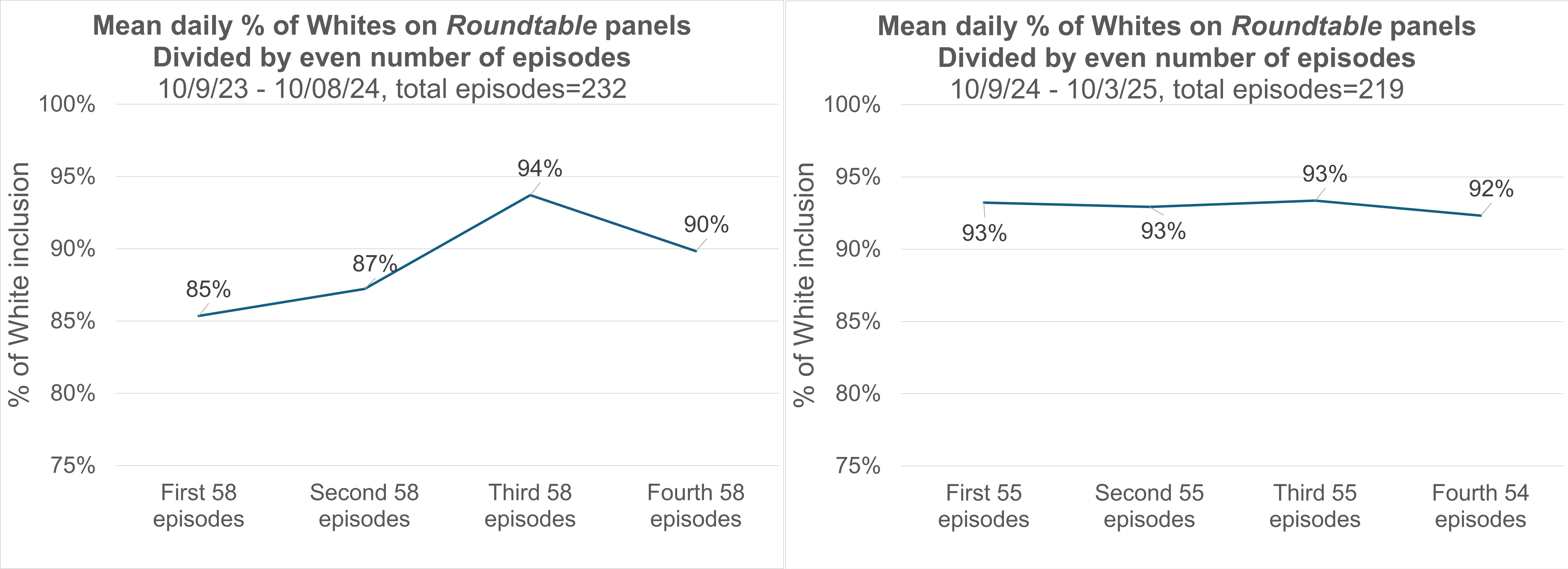
Daily racial diversity on daily Roundtable panels declined over the past year. Whites averaged between 85% and 94% of panelists on daily episodes between 10/9/23 and 10/8/24, as I previously documented. The new data shows White proportions of daily panels grew to a steady 92-93% from 10/9/24 to 10/3/25, marking losses in racial diversity in 3 quarters. This 7-8% representation of BIPOC people on Roundtable panels is one-third the 25% proportion People of Color occupy in WAMC’s broadcast region.
Figure 2.
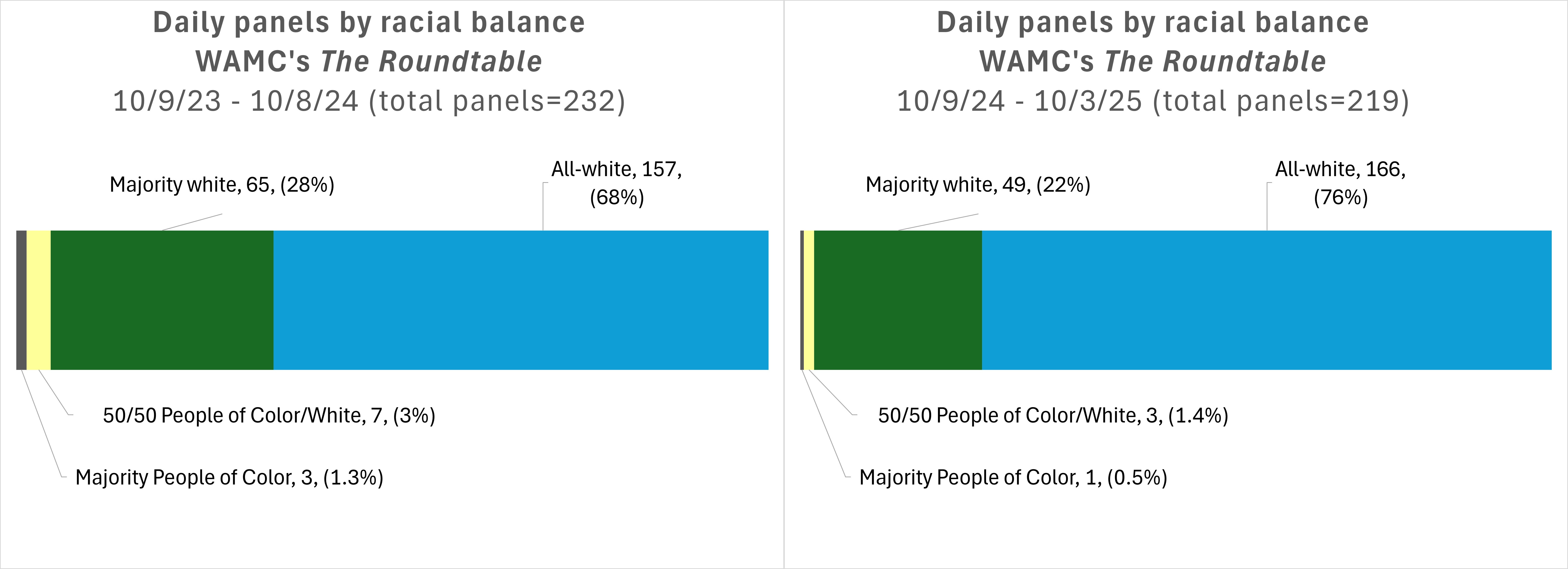
While white dominance over Roundtable panels was the normal pattern last year, this year that pattern grew more extreme. Last year (10/9/23-10/9/24), over 95% of panels were either all-white (68%) or majority white (28%) and only 1.3% were majority People of Color (Figure 3). This year (10/9/24-10/3/25) over 98% of all panels were all-white (76%) or majority white (22%). In other words, during the time span encompassing Trump’s first nine months in office and the entire second year of the Gaza war, less than 2% of Roundtable panels featured racial balance or majority BIPOC guests. Across the 451 Roundtable episodes over the past two years — covering the entirety of the Gaza war, the racially charged 2024 US presidential election, and nine months of racialized arrests and illegal deportations by militarized federal police — the number of Roundtable panels featuring all People of Color was zero (0). In stark contrast, all-white panels numbered 323.
Figure 3.
The number of all-white panels on The Roundtable is NOT a reflection of WAMC’s broadcast region
It might be tempting to explain the ‘racial imbalance’ on The Roundtable as a natural result of WAMC’s overly white broadcast area. Resist the temptation! For the 232 episodes during 2023-24, with average panel size of 3.5 drawn from the station’s 75% white, 7-million-person broadcast region, there is a 99.7% probability that the number of all-white panels would range from 63 to 107.12 The probability of reaching Roundtable’s 157 all-white panels that year in is roughly 0.00000000000000000006737%.13 For the 219 episodes during 2024-25, it is 99.7% likely that the total number of all-white panels would range from just under 60 to just over 100 (Figure 4). The probability of reaching the 166 all-white panels Roundtable produced in 2024-25 is thus worse: 0.000000000000000000000000000018%.14 Both figures are what statisticians call astronomical improbabilities (Siegenfeld & Bar-Yam, 202015). You have a higher chance of winning Powerball (1 in 292 million) than drawing The Roundtable’s racial balance from WAMC’s broadcast area. In other words, the racial imbalance is definitely and unarguably NOT a chance reflection of the region’s racial demographics.
Figure 4.
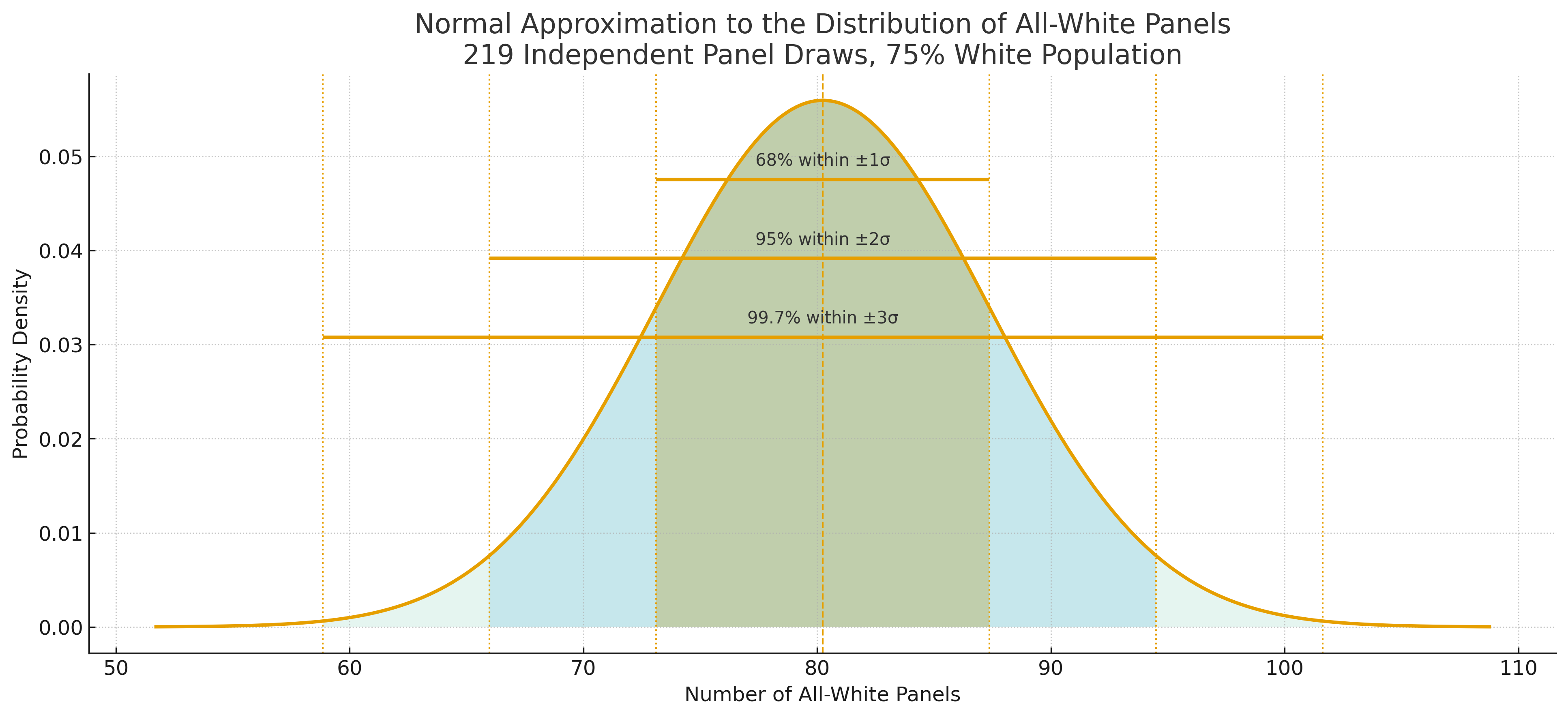
The Roundtable’s astronomically improbable exultation of whiteness is instead the result of Roundtable producer practices. Those practices violate WAMC management’s own diversification policies, which specify proportionality with the broadcast area as a standard for diversity in programming: “The overall goal of WAMC is to provide programming as varied as the human experience” and to do so by creating “programs that celebrate the diversity of our broadcast and live audience.” WAMC is clearly not enforcing this policy when it comes to The Roundtable.
Conclusion: Will WAMC fulfill its own promises to listen to audiences and address racial exclusions? Only if we compel them to do so.
This post fulfills WAMC management’s own criteria (Guidestar, 2025) for audience feedback worthy of listening to and addressing: The post presents complete data on two-years of Roundtable episodes and identifies extreme racial inequities. I am a donating member of the station and my concerns are echoed in petitions, community outreach, a presentation to the station Trustees, and hundreds of letters to the station over the past 2 years. Listeners have made the problem of racial bias on the show known to management and producers.
Will station managers and producers allow racial diversity on The Roundtable to continue to decline, as they did for the past year? The data I present above would make an excellent complaint and demand for inquiry to the Ombuds office at the Corporation for Public Broadcasting (CPB), the federal funding source that provided WAMC over $400,000 in 2024 (WAMC IRS 990, p. 9). However, with the Trump administration executive order eliminating the CPB and its grants for public media (Current, 5/2/25), federal means of accountability for racial discrimination has disappeared. With the station ever more dependent upon the donations of listeners, I hope listeners will be ever more vigilant about the racial politics they empower.
It almost seems as if Roundtable producers and WAMC management think that if they just ignore the situation long enough people will stop complaining about racist and colonialist bias on the program. Emergence of the new activist organization Truth + Justice 4 Palestine suggests that WAMC will be hearing more, not less, from communities who care about these issues. T+J4P is campaigning for recognition of Palestinian humanity on The Roundtable, at WAMC, and on mainstream media across New England. Full disclosure, members of that organization provided some research labor for my latest data and I am participating with that organization. If more people join our struggle, WAMC decision makers may find themselves compelled treat People of Color, Palestinians and Middle Easterners, and pro-Palestine advocates as human beings whose knowledge and experiences of oppression rightfully belong in discussions about what is to be done about those oppressions. Join us.
Data referenced in this post is available on GitHub. Check the ReadMe file for field descriptions.
Comment starts at 1:17:33 in the audio recording provided by WAMC. https://www.wamc.org/podcast/the-roundtable/2024-09-19/9-19-24-live-panel-at-the-linda
Comment starts at 1:05 in the audio recording provided by WAMC. https://www.wamc.org/podcast/the-roundtable/2025-07-08/wamc-on-the-road-the-roundtable-live-from-the-colonial-theatre-in-pittsfield-ma-7-8-25
I address why ‘genocide’ is the accurate term for the war in a prior post.
Israel violated the 10/9/25 ceasefire, according to the Trump administration (Axios, 12/15/25). Israel also continues bombing and killing Palestinians and limiting food and other aid below levels required in the peace agreement (Amnesty International, 12/1/25).
New York Times, (June 20, 1899). ‘CONFERENCE OF ZIONISTS; Elect Delegates at Their Meeting in Baltimore. WILL COLONIZE PALESTINE Rabbis Gottheil and Wise Were Chosen Members of the International Executive Committee,’ https://www.nytimes.com/1899/06/20/archives/conference-of-zionists-elect-delegates-at-their-meeting-in.html
Khalidi, R. (2020). The hundred years’ war on Palestine: A history of settler colonialism and resistance, 1917–2017. Metropolitan Books.
Tina Al-khersan, Azadeh Shahshahani (2025). ‘The Colonial Order Prevails in Palestine: The Right to Self-Determination from a Third World Approach to International Law,’ Yale Journal of International Law. https://yjil.yale.edu/posts/2025-07-14-the-colonial-order-prevails-in-palestine-the-right-to-self-determination-from-a
Grandin, Greg (2025). America, América: A New History of the New World. New York: Penguin Random House.
Gwatiwa, T., & van der Merwe, J. (Eds.). (2020). Expanding US Military Command in Africa: Elites, Networks and Grand Strategy (1st ed.). Routledge. https://doi.org/10.4324/9780429449901
Scharrer, E., Ramasubramanian, S., & Banjo, O. (2022). Media, diversity, and representation in the US: A review of the quantitative research literature on media content and effects. Journal of Broadcasting & Electronic Media, 66(4), 723-749. https://www.tandfonline.com/doi/full/10.1080/08838151.2022.2138890
Len-Ríos, M. E. (2023). ‘Journalistic Norms and Their Role in the Perpetuation of Racial Inequities.’ In Political Communication, Culture, and Society (pp. 115-131). Routledge. https://www.taylorfrancis.com/chapters/edit/10.4324/9781003391692-6/journalistic-norms-role-perpetuation-racial-inequities-mar%C3%ADa-len-r%C3%ADos
X ~ Binomial(n=232, p=0.365)
n=232 (number of panels), p = 0.75^(3.5) (probability a single panel is all-white), 3 standard deviation band = 63 ≤ X ≤ 107
This means there is a 99.7% probability of drawing between 63 and 107 all-white panels across 232 panels with 3-4 size drawn from a 7 million population that is 75% white.
6.737 × 10⁻²²
Try it yourself using Giga-Calculator — which rounds the probability to 0.
1.8 × 10⁻³¹
Siegenfeld, A. F., & Bar-Yam, Y. (2020). An introduction to complex systems science and its applications. Complexity, 2020, Article 6105872. https://doi.org/10.1155/2020/6105872
Thank you for this carefully researched statistical analysis of the WAMC Roundtable's inexcusable history and ongoing practice of xenophobia, anti-Palestinian bias, and racism. I am so glad that what I experienced first hand and spoke out about as a panelist on the Roundtable in 2016 and 2017 is once again being brought to light.