

Research assistance provided by Truth and Justice for Palestine (TJ4P) As always, complete data available on GitHub. Check my work, please.
Our call-in campaign is having effects! Sources inside WAMC report that staff and management want improved racial inclusion on The Roundtable. Let’s show them that lots of listeners demand it!
WAMC fund-drive: 800-323-9262
WAMC’s fund drive volunteers, and station management, could sure benefit from knowing what you know, that racial bias on The Roundtable is a real and measurable problem. As the data presented in this post will show:
In the past 6 months, white panelists appeared about 8 times as often as panelists of color.
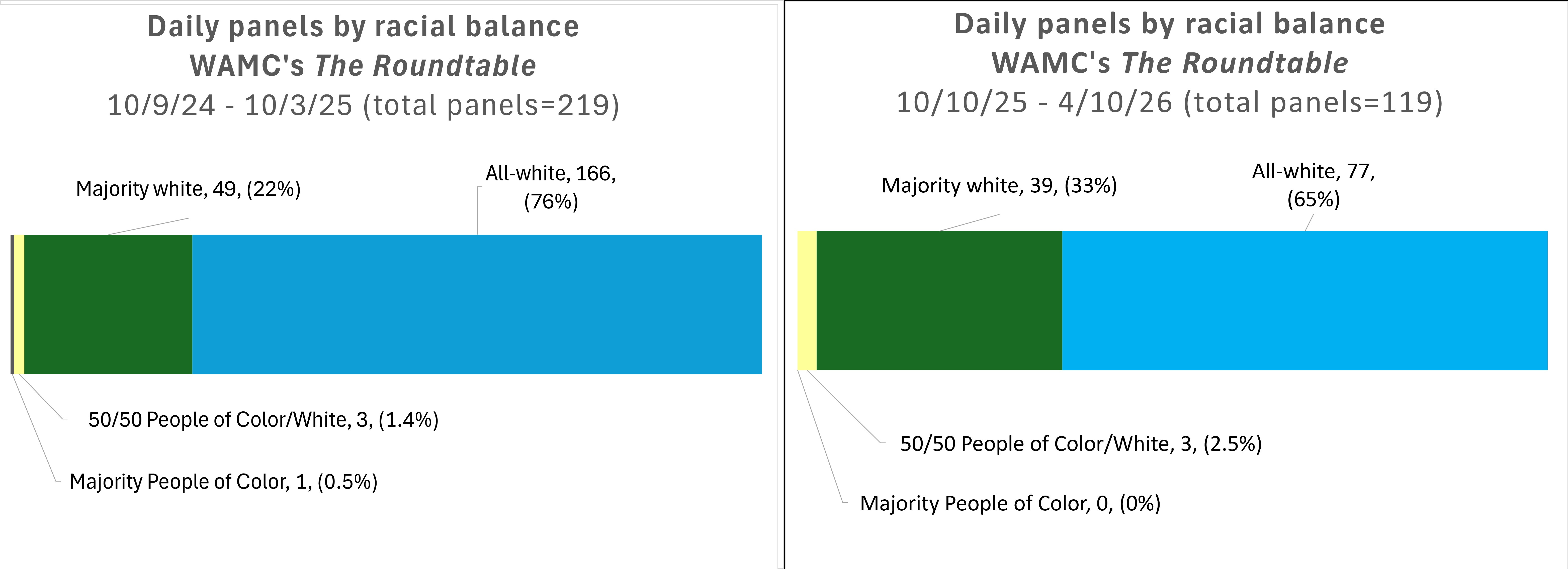
Two-thirds (65%) of episodes presented all-white panels. Another 33% of panels were majority white. A mere 3 episodes (2.5%) included even numbers of whites and panelists of color. Zero episodes included all or a majority of panelists of color.
Whites have dominated Roundtable panels for two and a half years.
The Roundtable’s racial imbalance violates WAMC’s Code of Ethics and its Community Representation policy.
You can help hold WAMC accountable! How? Call in to their ongoing fund-drive and tell them you do not support racial segregation or tokenism on public media! Today’s post offers hard numbers and relevant context, making good talking points to help inform WAMC volunteers about racism on The Roundtable!
WAMC fund-drive: 800-323-9262
Now let’s check the numbers!
Whites appear 8 times more often than people of color on The Roundtable
Whites appear far more often than people of color on The Roundtable, to put it mildly. Across the 119 episodes in the six months from 10/10/2025 to 4/10/2026, 52 unique panelists made a total of 399 appearances. White panelists accounted for 89% of those appearances (n=354), and panelists of color the remaining 11% (n=45) (Figure 1). In other words, in the six months since October, 2025, whites appeared about 8 times as often as panelists of color on The Roundtable.1 As with the prior two years, zero Native Americans appeared.
Figure 1. Racial inclusion on Roundtable: Comparing the latest 6-months to the prior year
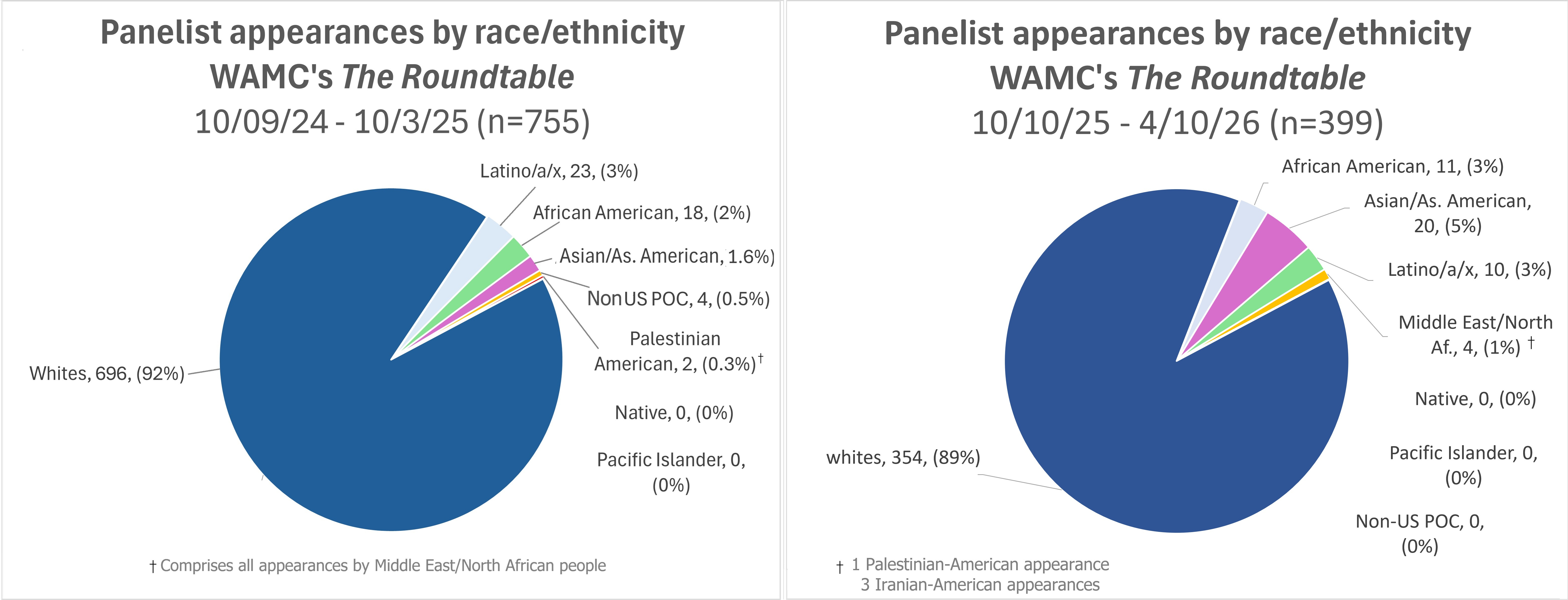
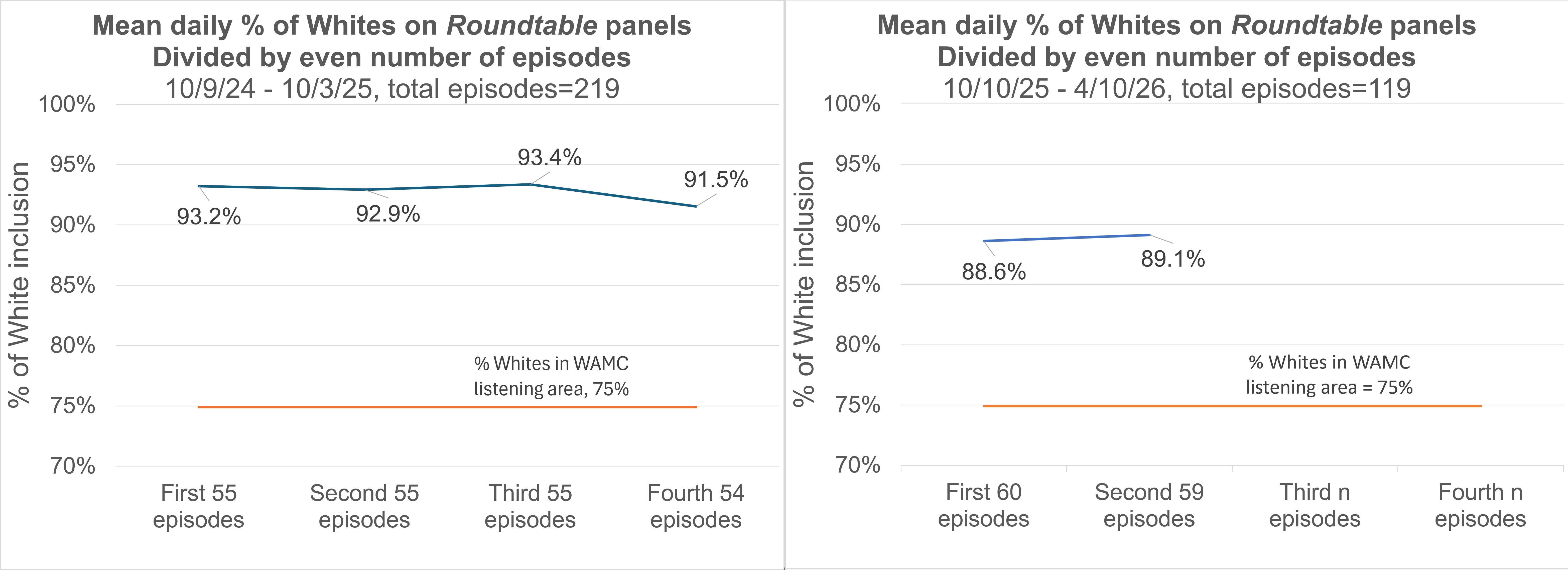
Across the past 6-months, people of color appear on average about one-half of the 25% rate they appear in the broadcast region population. This is actually a 3% improvement over the 92% white appearance average over the prior 12 months (Figure 2) but about the same as the 88% of appearances whites made on the show from 10/2023 to 10/2024. In other words data shows a consistent pattern of failure to include people of color at a rate comparable to their portion of the regional community let alone commensurable to the appearance rate of white panelists. Across the past two and a half years, white panelists consistently appeared around 10 times as often as panelists of color.
Figure 2.
Appearances by Palestinian and Middle East panelists remain marginal — while IDF ‘partner’ Robert Griffin appears frequently
I applaud Roundtable producers for adding panelist Mahmood Karimi-Haka, an Iranian playwright and Siena College professor, and for the return of Dr. Ahmad Abu-Hakmeh, a Palestinian-American scientist. Karimi-Haka appeared 3 times and Dr. Abu-Hakmeh appeared once, accounting for all apperances by Middle East/North African (MENA) panelists in the 6-month period. While meagre, these appearances already exceed the paltry 2 MENA appearances across the entire prior year and match the 4 MENA appearances between 2023-2024.
WAMC staff and management need to further increase MENA appearances over the next six months, especially as the program so frequently includes guests like Robert Griffin, a UAlbany administrator who manages a partnership with the Israeli Defense Forces. Griffin alone made 15 appearances across the 6-months of the data compared to the combined 4 appearances by Karimi-Haka and Abu-Hakmeh. Roundtable producers book guests about 3 months in advance, according to my inside sources. If MENA panelists have not yet been booked, producers could bump Griffin from the schedule to make room for perspectives heard far less frequently on the show.
All-white panels continue to be the norm on The Roundtable
All-white panels accounted for 65% of all episodes from 10/10/25-4/10/26 (Figure 3). This 6-month period shows a return to the levels of white dominance seen in 2023-2024, the first year of Israel’s genocidal war on Gaza, when 66% of panels exclusively featured white panelists. The second year of the war showed slightly worse diversity, with 77% of panels exclusively featuring whites. The most recent period also stands out for its complete lack of majority BIPoC panels, whereas last year featured 1 such panel and 3 the prior year.
Figure 3.
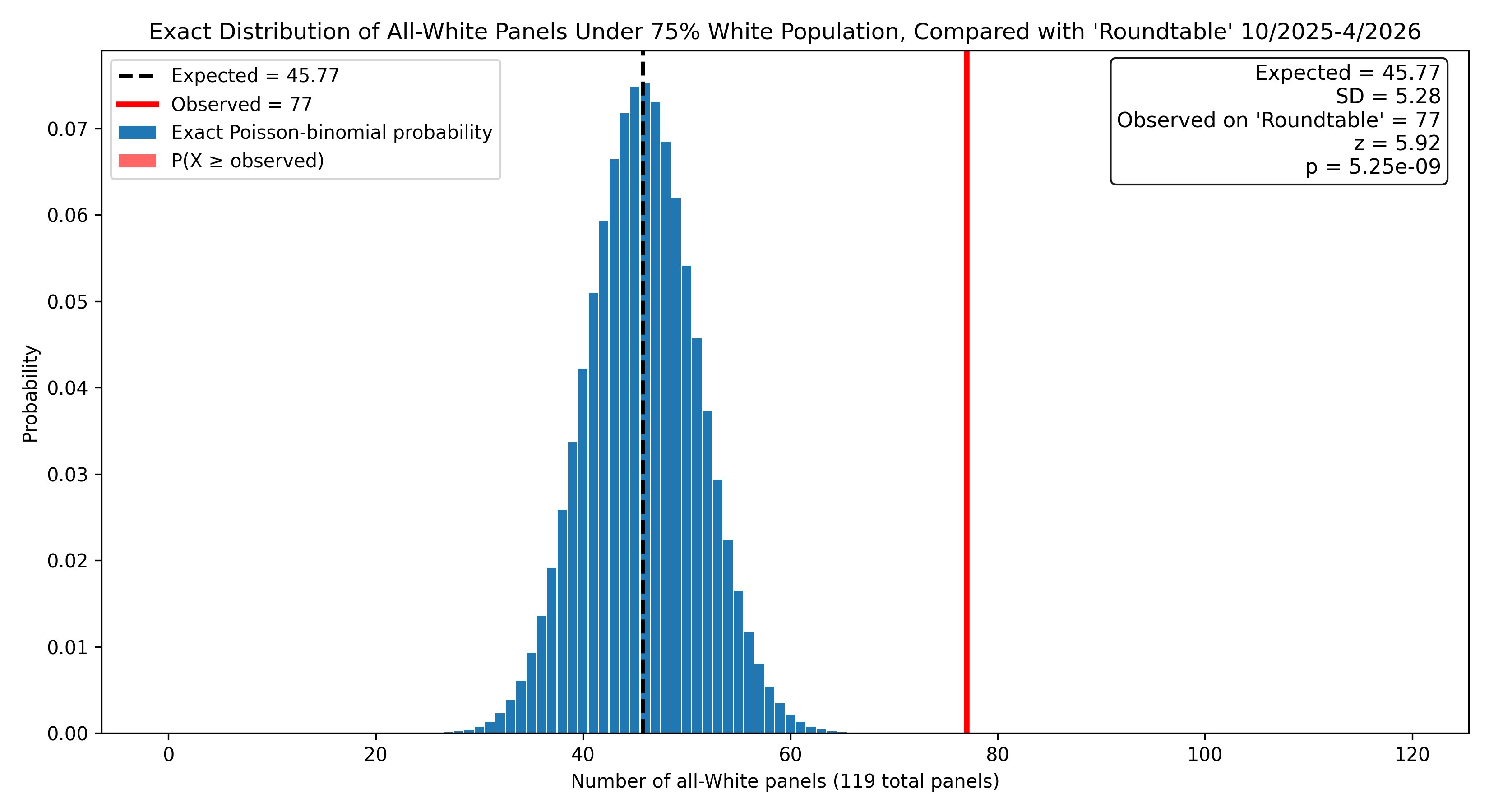
Such a high proportion of all-white panels is NOT a reflection of WAMC’s broadcast region! WAMC’s broadcast region is 75% white / 25% BIPoC. Drawing 119 panels from that population, according to Poisson’s binomial model,2 one is 99.7% likely to get 30 to 60 all white panels (Figure 4). The probability of drawing 77 all-white panels, as observed on The Roundtable, is about 1 in 190 million (or 5.9 standard deviations above the mean). Racial disparities on The Roundtable are not a reflection of the broadcast region.
Figure 4. Probability estimate for the number of all-white panels across the 119 Roundtable episodes, 10/10/24-4/10/26
As pointed out for over two years, patterns of racial bias on The Roundtable violates WAMC’s own policies
The data shows unmistakably that The Roundtable has not made measurable progress in racial diversity over the past two and a half years. Current and former WAMC personnel reported to me that the Board of Trustees and WAMC CEO Sarah Gilbert are working on improving the diversity of The Roundtable. I cheer them on and look forward to seeing the fruits of those efforts in future programs!
(Yet one wonders why those efforts did not begin years ago. We can’t blame Alan Chartock anymore, he resigned in 2023!)
But we cannot simply wait on the board and Gilbert to act. The fact is clear that Roundtable producers’ source selection practices do not reflect the demographics of the broadcast area. That is a violation of WAMC’s policies proclaiming that programs should reflect the racial balance of the broadcast area: “Our mission is to serve the public by preparing and presenting non-profit . . . programs that celebrate the diversity of our broadcast and live audience,” (WAMC, Community Representation Statement, 11/2025).
Now, some argue that professional journalistic practices, including source selection, are less an effort to reflect local preferences but, as Prof. Thomas Schmidt (20243) writes , to “establish[] a shared sense of reality, making sure that depictions are supported by evidence and checked against challenges of their validity” (p. 558). From that view, panelists of color are essential to prevent normalization of white standpoints, “to acknowledge social inequities and collective trauma of marginalized groups, and . . . to address concealed power structures” (p. 549). From this kind of objective perspective, the past two and a half years should feature especially high levels of racial inclusion in order to cover the many racialized political forces dramatically affecting domestic and international political life.
For freaking example: Trump’s overtly racist presidential campaign, the candidacy of African American Kamala Harris, Trump’s election and implementation of racist policies, US support for Israel’s war on Gaza (articulated by Israeli leaders in overtly racial terms), and the violent and ongoing suppression of pro-Palestine student movements mischaracterized as racist ‘antisemites.’ Yet the inclusion of panelists of color on The Roundtable was marginal during that period and continues to be marginal today!
Racially different appearance rates on ‘The Roundtable’ need to be recognized as racially different access to political participation.
The Roundtable is an important means of regional political communication reaching high-voting and higher than average income communities as well as city, state, and federal law makers. As the data shows, and WAMC is yet to show otherwise, whites receive far more access to use this means of political communication to influence lawmakers, regional neighbors, and build support for their agendas.
It is my suspicion that WAMC has a special relationship with the New York State Democratic Party. The station provides platforms for NY Democratic Party allies to share party agendas with white voters of higher-than-average wealth. Those white voters get programs that affirm their sense of identity as ‘good people’ who are ‘not racist.’ Both groups are protected from people to the left of the Democratic party who threaten that identity and undermine Democratic party agendas with inconvenient facts, perspectives, and potentially better agendas. It’s a win-win for liberal centrist audiences and centrist party officials.
Except that those centrist audiences are generally 65 years old and up! This is not a sustainable audience, as I have argued for more than two years. To attract a younger and more diverse audience WAMC needs to expand their listenership. But that younger more diverse audience also lacks the money of WAMC’s preferred demographic. So, it turns out, WAMC’s racism problem may also be a class problem. Which side are you on, WAMC?
354 / 45 = 7.9
Poisson’s binomial distribution is fun because it’s increased precision results from using the full list of Bernoulli trials (in this case, the exact number of panelists on each of the 119 episodes) rather than an average. Nerd!
Schmidt, T. R. (2024). Challenging journalistic objectivity: How journalists of color call for a reckoning. Journalism, 25(3), 543–560. https://journals.sagepub.com/doi/pdf/10.1177/14648849231160997